
Numbers are everywhere. From telling the time and counting change to following a recipe, reading a bus timetable, and managing a budget, numerical understanding is woven into virtually every aspect of daily life. For children with dyscalculia, this omnipresence of numbers is not a source of comfort but a constant reminder of a difficulty that affects them deeply, pervasively, and in ways that are rarely acknowledged or understood with the same clarity and compassion as other learning difficulties.
Dyscalculia is often called the forgotten learning difficulty. While dyslexia has gained significant public awareness and educational recognition over recent decades, dyscalculia remains poorly understood, frequently misidentified, and consistently underserved by educational systems that do not yet have the specialist knowledge or resources to support affected children effectively. Consequently, children with dyscalculia often spend their school years believing they are simply bad at maths, that numbers will never make sense to them, and that mathematical failure is simply part of who they are.
None of this is true. Dyscalculia is a specific, neurologically-based learning difficulty that affects the way the brain processes numerical and mathematical information. It has nothing to do with general intelligence, effort, or attitude. Furthermore, with the right specialist support, delivered at the right time, children with dyscalculia can develop genuine mathematical understanding and numerical confidence that transforms their relationship with numbers and their access to the full curriculum.
Dyscalculia support and therapy for children in Bangalore is helping families access the specialist assessment, targeted intervention, and educational support that their child needs to unlock their mathematical potential and build the confidence that consistent mathematical failure has eroded.
At Aarumi in Bengaluru, we work with children with dyscalculia and their families with a commitment to genuine understanding, evidence-based intervention, and the belief that every child can develop mathematical competence with the right support behind them.
What Is Dyscalculia?
Dyscalculia is a specific learning difficulty that primarily affects a child’s ability to understand, process, and work with numerical and mathematical information. It is neurological in origin and results from differences in the way specific areas of the brain process numerical magnitude, quantity, and the relationships between numbers.
Dyscalculia affects approximately five to seven percent of the population, making it as common as dyslexia, though significantly less recognised and less well-served by educational provision. It affects males and females roughly equally and occurs across all levels of general intelligence and all socioeconomic and cultural backgrounds.
Like dyslexia, dyscalculia exists on a spectrum of severity. Some children experience mild numerical processing difficulties that, with targeted support, can be largely overcome. Others experience more severe difficulties that persist throughout their education and require ongoing accommodations and support strategies throughout their lives.
Furthermore, dyscalculia frequently co-occurs with other learning difficulties and neurodevelopmental conditions including dyslexia, ADHD, dyspraxia, and working memory difficulties. Consequently, a thorough assessment that considers the full profile of a child’s learning is essential for effective intervention planning.
How Dyscalculia Presents in Children
Dyscalculia presents differently at different ages and stages of development, and its profile varies from one child to the next. However, certain patterns of difficulty are characteristic of the condition and distinguish it from ordinary mathematical difficulty or inadequate teaching.
In early childhood and reception year:
- Difficulty learning to count reliably and in the correct sequence
- Difficulty understanding that the last number counted represents the total quantity
- Poor number sense and difficulty comparing small quantities without counting
- Difficulty learning and remembering number names and their written symbols
- Confusion between number symbols that look similar
- Difficulty understanding basic concepts of more and less
In primary school:
- Persistent difficulty with basic number facts including addition, subtraction, and times tables
- Reliance on finger counting well beyond the age at which peers have developed automatic recall
- Difficulty understanding place value and the structure of the number system
- Confusion with mathematical symbols and operations
- Difficulty estimating quantities and checking whether answers are reasonable
- Significant anxiety around mathematics lessons and assessments
- Strong discrepancy between mathematical performance and performance in other subjects
- Difficulty with telling the time, particularly on analogue clocks
- Difficulty handling money and calculating change
In older children and adolescents:
- Continuing difficulty with mathematical facts and procedures despite extensive practice
- Significant reliance on calculators and other compensatory tools
- Difficulty with algebra, fractions, ratios, and other abstract mathematical concepts
- Avoidance of subjects and career paths involving mathematical content
- Mathematics-specific anxiety that may generalise to broader academic anxiety
- Strong discrepancy between mathematical performance and general intellectual ability
The Neurological Basis of Dyscalculia
Understanding the neurological basis of dyscalculia is important because it clarifies why conventional mathematics teaching methods often fail children with the condition and why specialist intervention is necessary.
Research has identified that dyscalculia is associated with differences in the functioning of the intraparietal sulcus, a region of the parietal lobe that plays a central role in processing numerical magnitude and the approximate number system. The approximate number system is the intuitive, non-verbal sense of quantity that allows humans and other animals to rapidly estimate and compare quantities without counting.
Children with dyscalculia show reduced precision in their approximate number system, meaning that their intuitive sense of numerical magnitude is less accurate and less reliable than that of typically developing children. Consequently, the rapid, automatic number processing that underlies mathematical fluency does not develop as it does for most children, and mathematical learning remains effortful, unreliable, and anxiety-provoking.
According to the British Dyslexia Association, which covers dyscalculia alongside dyslexia in its advocacy and research work, dyscalculia requires specific, evidence-based intervention that addresses the underlying numerical processing difficulties rather than simply providing additional practice with standard mathematical methods.
Dyscalculia Assessment: Building a Clear Picture
A thorough dyscalculia assessment provides families and educators with a detailed, accurate picture of a child’s numerical processing strengths and difficulties, the cognitive factors contributing to their mathematical challenges, and the most effective approaches to intervention and educational support.
A comprehensive dyscalculia assessment typically includes:
- Standardised assessment of mathematical achievement across number, calculation, and reasoning
- Assessment of numerical processing including number sense, magnitude comparison, and subitising
- Working memory assessment, including verbal and visual-spatial working memory
- Processing speed assessment
- Assessment of mathematical anxiety and its impact on performance
- Oral language and verbal reasoning assessment
- Educational history and parent and teacher observation
From this assessment, a detailed profile is developed that guides intervention planning, educational accommodation recommendations, and communication with the school. At Aarumi, our assessment approach is always thorough, individualised, and focused on building a complete picture of each child’s learning profile. To learn more about our assessment and intervention programmes, visit our programmes page.
Specialist Dyscalculia Intervention: What Works
Effective dyscalculia intervention differs fundamentally from standard mathematics remediation. Rather than simply providing more practice with the same methods that have already failed to work, specialist dyscalculia intervention addresses the underlying numerical processing difficulties directly, building the intuitive number sense and conceptual understanding that standard mathematics teaching assumes but dyscalculia disrupts.
Key principles of effective dyscalculia intervention include:
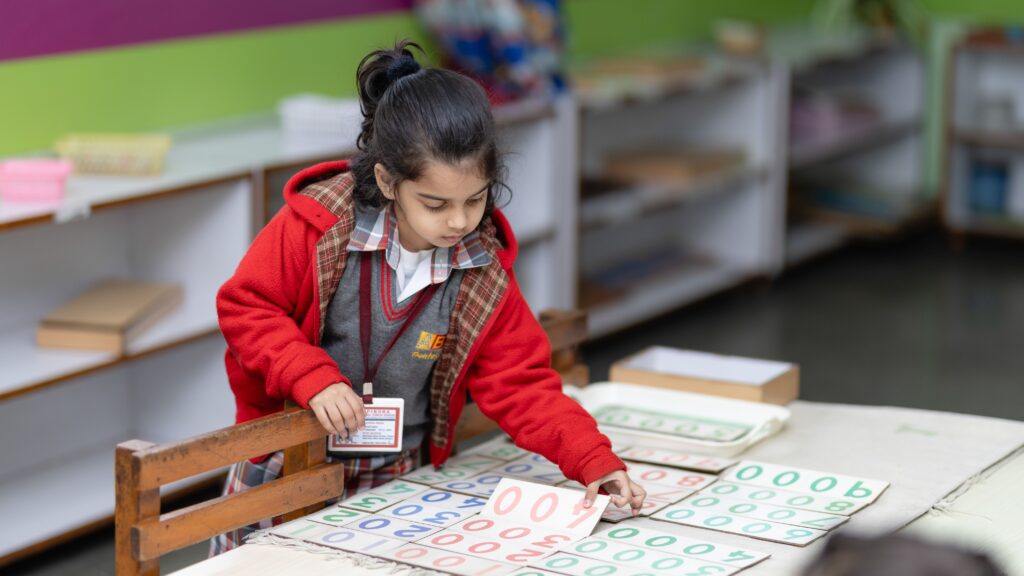
- Building number sense through concrete, visual, and structured activities before moving to abstract symbols
- Using manipulatives including counters, number rods, and structured materials to make numerical relationships tangible and visible
- Developing a deep, conceptual understanding of the base-ten number system
- Building automaticity for basic number facts through structured, multisensory practice
- Connecting numerical symbols to their underlying meanings and quantities at every stage
- Addressing mathematical anxiety alongside mathematical skill development
- Using a cumulative, systematic progression that builds on established understanding
- Providing frequent, distributed practice in short sessions rather than infrequent marathon sessions
- Celebrating every step of progress and building a positive mathematical identity alongside mathematical skill
Concrete, Pictorial, and Abstract Approaches
One of the most effective frameworks for dyscalculia intervention is the concrete-pictorial-abstract approach, which moves learning systematically from hands-on manipulation of physical objects through pictorial representation to abstract numerical symbols.
This approach is particularly effective for children with dyscalculia because it builds genuine conceptual understanding at the concrete and pictorial levels before requiring the child to work with abstract numerical symbols that have limited meaning for them. Consequently, mathematical learning becomes anchored in genuine understanding rather than rote memorisation of procedures that are not understood.
At Aarumi, our specialist intervention for dyscalculia uses the concrete-pictorial-abstract framework as the backbone of our approach, ensuring that every child develops a genuine, grounded understanding of mathematical concepts rather than a fragile, easily-lost collection of memorised procedures.
Managing Mathematical Anxiety
Mathematical anxiety is one of the most significant and most debilitating consequences of dyscalculia. Years of mathematical failure, embarrassment in front of peers, and the feeling of being the only person who does not understand something that seems obvious to everyone else create a level of anxiety around mathematics that becomes self-perpetuating.
Mathematical anxiety activates the brain’s threat response, which actually reduces the working memory capacity available for mathematical processing. Consequently, an anxious child performs significantly worse on mathematical tasks than their underlying mathematical ability would predict, creating a vicious cycle in which anxiety produces poor performance, which confirms negative beliefs, which increases anxiety.
Breaking this cycle requires addressing the anxiety directly alongside building mathematical skills. Strategies for managing mathematical anxiety include:
- Creating a safe, pressure-free learning environment in which mistakes are explicitly valued as learning opportunities
- Building genuine mathematical understanding that reduces the uncertainty driving anxiety
- Addressing negative self-beliefs about mathematical ability through cognitive approaches
- Gradually rebuilding positive mathematical experiences through appropriately calibrated challenges
- Teaching relaxation and self-regulation strategies for managing anxiety in mathematical situations
- Separating assessment from learning to reduce the performance pressure that activates anxiety
Supporting Children With Dyscalculia at School
School-based support is essential for children with dyscalculia to access mathematics education equitably and to achieve outcomes that reflect their genuine potential. Effective school support for children with dyscalculia typically includes:
- Specialist mathematics support from a teacher trained in dyscalculia intervention
- Extended time for mathematics tests and examinations
- Calculator access for calculation-heavy tasks that are assessing mathematical reasoning rather than arithmetic skill
- Multiplication tables and number facts reference sheets during assessments
- Concrete manipulatives available during mathematics lessons
- Reduced emphasis on timed mathematics tasks that exacerbate anxiety
- Multisensory and concrete teaching approaches across mathematics topics
- Regular communication between specialist support staff, classroom teachers, and parents
Furthermore, it is important for schools to distinguish between dyscalculia and general low mathematical attainment, because the intervention approaches needed are different. At Aarumi, we work closely with families and schools to communicate the specific nature of dyscalculia and the evidence-based approaches that genuinely work. To learn more about how we collaborate with families and schools, visit our About page.
Assistive Technology for Dyscalculia
Assistive technology plays an important role in supporting children with dyscalculia to access mathematical content and demonstrate their understanding without being held back by the specific processing difficulties that dyscalculia creates.
Useful assistive technology for dyscalculia includes:
- Scientific calculators for computation-heavy tasks
- Digital clocks and timers to support time management without analogue clock difficulties
- Money calculation apps to support financial independence
- Mathematical software that provides visual and interactive representations of numerical concepts
- Text-to-speech software for word problems and mathematical text
- Structured spreadsheet tools for managing numerical information
The Broader Strengths of Children With Dyscalculia
It is important to recognise that dyscalculia is a specific difficulty with numerical processing and does not reflect or limit a child’s overall intellectual ability or their potential for success across the vast majority of human endeavours.
Many children with dyscalculia demonstrate remarkable strengths in verbal reasoning, creative thinking, social intelligence, artistic expression, and leadership. Furthermore, many successful professionals across fields including law, medicine, literature, art, business, and politics have dyscalculia, managing their numerical processing difficulties through a combination of compensatory strategies, assistive technology, and genuine strength in the non-numerical dimensions of their work.
Building a positive identity that acknowledges the specific challenge of dyscalculia while firmly situating it within a broader picture of genuine intelligence and capability is one of the most important things that families, educators, and therapists can do for children with this condition.
Every Child Deserves to Feel Confident With Numbers
Mathematical confidence is not a luxury. It is a practical necessity for navigating daily life, accessing the full curriculum, and pursuing the career and life options that every child deserves. Dyscalculia does not have to mean a lifetime of mathematical avoidance, anxiety, and limitation.
With the right specialist support, at the right time, delivered by someone who genuinely understands how dyscalculia affects mathematical learning, children with dyscalculia can develop real numerical understanding, genuine mathematical confidence, and the practical number skills they need to navigate their world with competence and ease.
At Aarumi, we have seen children who had given up entirely on ever understanding mathematics begin to experience genuine mathematical insight and growing confidence through specialist intervention. Those moments of breakthrough are among the most rewarding we experience, and they remind us every day why this work matters.
If you are looking for dyscalculia support and therapy for your child in Bangalore, reach out to our team at Aarumi today. We are here to help your child build the numerical confidence, mathematical understanding, and academic success they deserve.