Movement is at the heart of everything a child does. Before a child reads their first word, solves their first problem, or makes their first friend, they move. They reach, roll, crawl, stand, and eventually walk their way into an understanding of the world around them. Motor development is not separate from cognitive, social, and emotional development. It is deeply intertwined with all of it, providing the physical foundation on which every other area of learning and growth is built.
For children with special needs, motor skills development often requires deliberate, structured, and highly personalised therapeutic support. Motor skills development for special needs children in Bangalore is helping families across the city give their children the physical tools they need to move through the world with greater confidence, capability, and independence.
At Aarumi in Bengaluru, motor skills development is a central thread running through our occupational therapy and physiotherapy programmes, because we know that a child who can move well is a child who can engage fully with every opportunity that life presents.
What Are Motor Skills?
Motor skills are the learned abilities that involve the coordinated use of muscles to perform specific movements and tasks. They are broadly divided into two categories, each equally important to a child’s overall development and daily functioning.
Gross motor skills involve the large muscle groups of the body and underpin whole-body movements such as:
- Rolling, crawling, and walking
- Running, jumping, and climbing
- Balancing and coordination
- Throwing, catching, and kicking
- Swimming and physical education activities
- Navigating stairs, slopes, and uneven surfaces
Fine motor skills involve the small muscles of the hands and fingers, working in coordination with the eyes, to perform precise and controlled movements such as:
- Holding and using a pencil or crayon
- Cutting with scissors
- Buttoning, zipping, and fastening clothing
- Manipulating small objects and puzzle pieces
- Using cutlery independently
- Typing and using a keyboard or touchscreen
Both gross and fine motor skills are essential for school readiness, daily independence, and meaningful participation in play, learning, and community life. Consequently, when either area is significantly delayed or underdeveloped, the impact is felt across virtually every dimension of a child’s daily experience.
Who Benefits From Motor Skills Development Support?
Motor skill delays are common across a wide range of developmental conditions. Children who frequently benefit from structured motor skills support include those with:
- Cerebral palsy
- Down syndrome
- Developmental coordination disorder, also known as dyspraxia
- Autism spectrum disorder
- Hypotonia or low muscle tone
- Sensory processing disorder
- Global developmental delay
- Premature birth related developmental challenges
- Intellectual disabilities
- ADHD and attention difficulties
Furthermore, children without a formal diagnosis who are consistently struggling with age-appropriate physical activities, falling behind peers in physical education, or avoiding tasks that require motor precision often benefit significantly from assessment and targeted motor skills support.
The Connection Between Motor Development and Learning
The relationship between motor development and cognitive learning is deeper and more significant than many people realise. Research consistently shows that children with well-developed motor skills perform better academically, demonstrate stronger attention and executive function, and show greater social confidence than those with significant motor delays.
This connection exists because many of the same neural pathways that support motor coordination also support attention, memory, and learning. Furthermore, the experience of moving confidently through the world provides children with a rich foundation of embodied knowledge that supports abstract thinking and problem-solving in the classroom.
According to the American Occupational Therapy Association, motor skill development is one of the most significant contributors to a child’s overall developmental health, influencing academic performance, social participation, and long-term quality of life across all developmental populations.
At Aarumi, we never treat motor development in isolation from the rest of a child’s developmental profile. Instead, we address it as part of a holistic, integrated support plan that recognises the deep connections between physical, cognitive, social, and emotional development. To learn more about our occupational therapy and physiotherapy programmes, visit our programmes page.
Assessment: Understanding Each Child’s Motor Profile
Effective motor skills development support always begins with a thorough, individualised assessment. A skilled occupational therapist or physiotherapist evaluates the child’s current motor abilities across both gross and fine motor domains, identifying specific areas of strength and difficulty and exploring the underlying factors that are contributing to any delays.
Assessment typically covers:
- Gross motor milestones and current physical abilities
- Fine motor control, grip, and hand function
- Balance, coordination, and body awareness
- Muscle tone and strength
- Sensory processing and its impact on motor function
- Visual motor integration and eye-hand coordination
- Motor planning and the ability to sequence new movements
- Postural stability and endurance
From this assessment, the therapist develops a personalised motor skills programme that targets the specific areas most likely to make the greatest difference to the child’s daily functioning and participation.
Gross Motor Development: Building the Physical Foundation
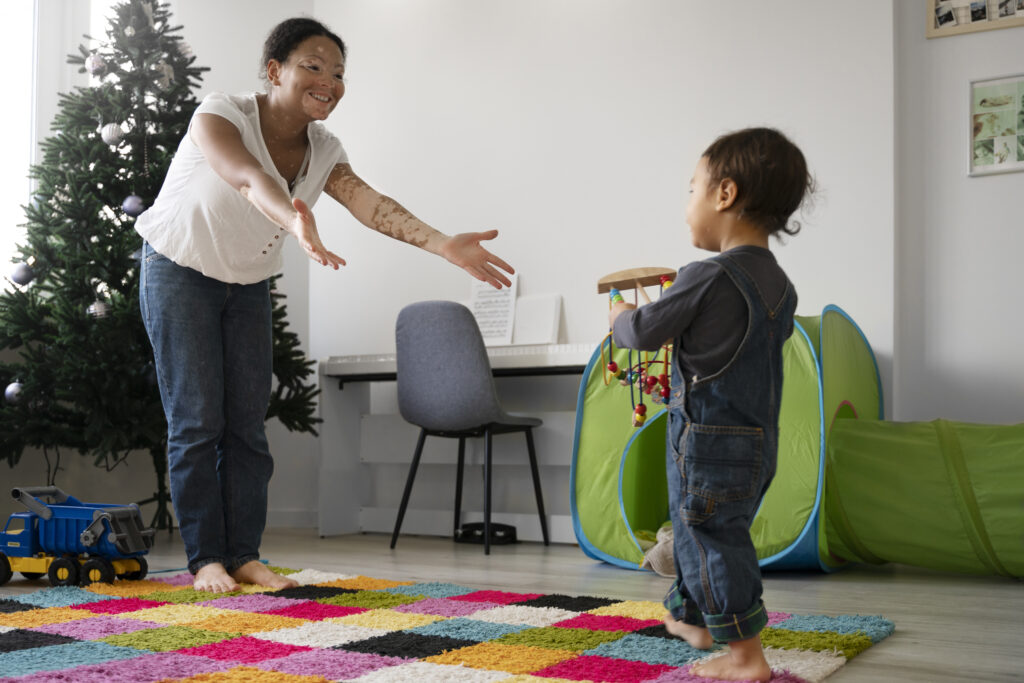
Gross motor development support focuses on helping children build the strength, coordination, balance, and physical endurance they need to participate fully in active daily life. For younger children, this might mean working towards foundational milestones like sitting independently, pulling to stand, or taking first steps. For older children, it might focus on improving running, jumping, ball skills, or the physical demands of navigating a school environment.
Therapy activities targeting gross motor development include:
- Obstacle courses and movement circuits targeting balance and coordination
- Trampolining and bouncing activities for vestibular stimulation and core strength
- Ball skills practice including throwing, catching, kicking, and rolling
- Climbing and crawling activities for upper body strength and coordination
- Swimming and hydrotherapy where appropriate
- Balance beam and stepping stone activities
- Yoga and movement-based mindfulness activities adapted for children with special needs
- Outdoor play and structured physical activities in natural environments
Gross motor therapy is most effective when it is playful, motivating, and structured around activities the child genuinely enjoys. Consequently, our therapists at Aarumi work hard to understand each child’s interests and incorporate them into gross motor activities wherever possible.
Fine Motor Development: Building Precision and Control
Fine motor development support focuses on helping children build the hand strength, finger dexterity, grip, and visual motor coordination they need for writing, drawing, self-care, and the many other daily tasks that depend on precise hand use.
Therapy activities targeting fine motor development include:
- Playdough, putty, and clay activities to build hand strength and finger isolation
- Threading, lacing, and bead activities to develop pincer grip and precision
- Cutting activities progressing from simple straight lines to complex shapes
- Pencil grip correction and pre-writing pattern practice
- Construction and building activities using blocks, Lego, and construction sets
- Peg boards, tweezers, and sorting activities targeting pincer grip
- Dressing frames for practising buttons, zips, and other fastenings
- Cooking and kitchen activities involving pouring, stirring, and food preparation
Fine motor activities are woven throughout many everyday home and school activities, which means that families have numerous natural opportunities to support fine motor development through the day without needing dedicated practice sessions.
Sensory Processing and Motor Development
Motor development and sensory processing are closely and reciprocally linked. A child’s ability to move accurately and efficiently depends significantly on the quality of the sensory information their brain receives from their body and environment. Proprioceptive input tells the brain where the body is in space. Vestibular input informs balance and movement. Tactile input guides the precision of hand movements.
When sensory processing is disrupted, motor function is often affected as a direct consequence. Conversely, targeted motor activities can significantly improve sensory processing and regulation. Therefore, at Aarumi, our motor skills development work always takes sensory processing into account, addressing both dimensions together for the most effective and lasting results.
Supporting Motor Development at Home
Motor skills develop through repetition and practice, which means that what happens at home between therapy sessions matters enormously. Fortunately, many everyday activities provide excellent opportunities for motor development without requiring any special equipment or dedicated practice time.
Simple activities that support gross motor development at home include:
- Active outdoor play in parks, playgrounds, and natural spaces
- Dancing, jumping, and movement games
- Riding a tricycle, balance bike, or scooter
- Swimming and water play
- Simple yoga or stretching routines
Simple activities that support fine motor development at home include:
- Drawing, colouring, and painting with different tools and media
- Playing with playdough, clay, or putty
- Building with blocks, Lego, or construction sets
- Completing age-appropriate puzzles
- Helping with simple cooking, baking, and kitchen tasks
At Aarumi, we provide families with personalised home activity programmes that target their child’s specific motor development goals, making it easy to build meaningful practice into everyday family life. To learn more about how we involve and support families throughout the therapeutic process, visit our About page.
Celebrating Every Physical Milestone
Motor development milestones are worth celebrating with genuine enthusiasm, because every one of them represents hard work, persistence, and growth. The first time a child manages scissors independently. The first time they catch a ball. The first time they navigate the climbing frame with confidence. These moments are not small. They are evidence of a child’s courage, determination, and capacity for growth.
At Aarumi, we celebrate these moments alongside families, because we know that physical milestones are not just about movement. They are about a child discovering what their body can do and building the belief that with the right support, they can do more.
Every child has the potential to develop greater physical capability, confidence, and independence than they currently possess. With consistent support, the right therapeutic approach, and a family that believes in them, children with special needs make motor development progress that surprises and inspires everyone around them.
If you would like to explore motor skills development support for your child in Bangalore, reach out to our team at Aarumi today. We are here to help your child build the movement skills they need to engage fully with every opportunity that life has to offer. American Occupational Therapy Association