
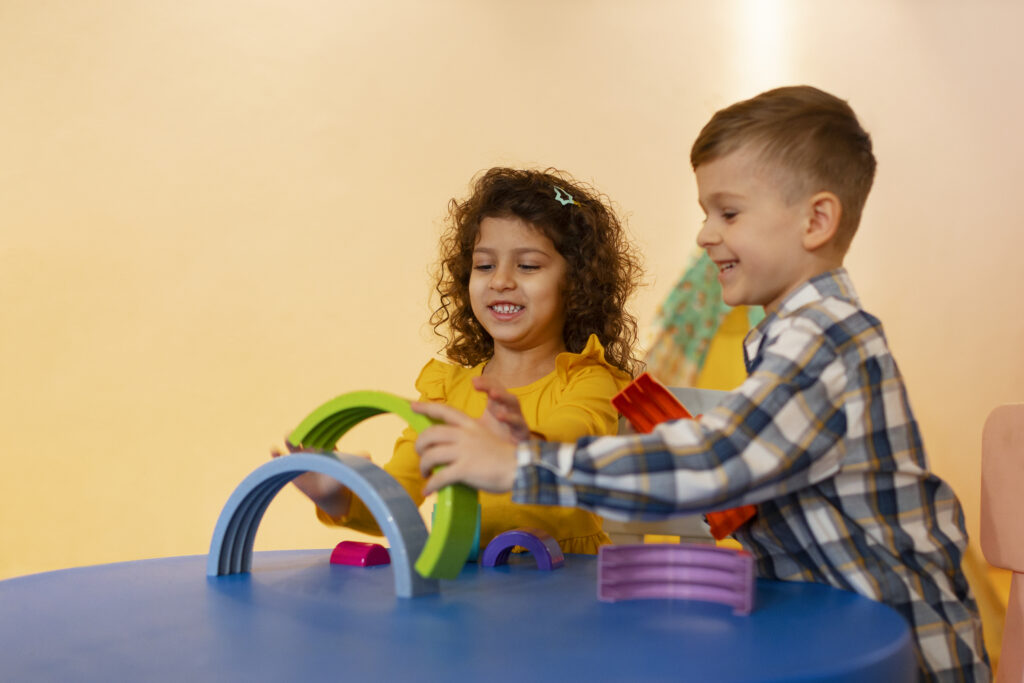
Play is not just something children do to pass the time. It is how they learn about the world, develop relationships, build language, and practise the social skills that will serve them throughout their entire lives. For children with special needs, play can sometimes feel more challenging than it should, and social situations that other children navigate effortlessly can require significant effort, support, and practice.
Inclusive play and social skills development for special needs children in Bangalore is helping families create opportunities for their children to connect, participate, and belong in ways that feel genuine and meaningful rather than forced or frustrating.
At Aarumi in Bengaluru, we believe that every child deserves the joy of play and the warmth of friendship, and we work hard to make sure every child we support has real opportunities to experience both.
Why Play Matters for Children With Special Needs
For typically developing children, play skills develop naturally through observation, imitation, and spontaneous interaction with peers. For children with special needs, these same skills often need to be taught deliberately, practised in structured settings, and supported over a longer period of time before they generalise into real-world social situations.
This does not mean that children with special needs do not want to play or connect with others. In the vast majority of cases, they absolutely do. What they need is the right support, the right environment, and enough opportunities to practise in a way that builds confidence rather than reinforcing feelings of failure or exclusion.
Play supports children with special needs to develop:
- Turn-taking and sharing
- Joint attention and shared focus with a partner
- Imitation and learning through observation
- Language and communication in a natural context
- Emotional regulation in the presence of others
- Conflict resolution and negotiation skills
- Friendship building and peer connection
- Imagination and creative thinking
- Resilience and coping with losing or not getting their way
What Social Skills Development Involves
Social skills development is a structured approach to teaching the unwritten rules of human interaction that most people pick up instinctively but that many children with special needs find genuinely puzzling. These rules include things like making eye contact during conversation, knowing when to speak and when to listen, reading facial expressions and body language, understanding personal space, and recognising when someone is interested in what you are saying versus when they want to change the subject.
For children with autism, ADHD, intellectual disabilities, and other developmental conditions, these skills are not intuitive. They need to be broken down, explained clearly, demonstrated, and practised repeatedly in a variety of contexts before they begin to feel natural.
Social skills development for special needs children typically covers:
- Greetings and conversation starters
- Maintaining and ending conversations appropriately
- Reading social cues and non-verbal communication
- Understanding and expressing emotions
- Managing disagreements and conflict with peers
- Joining group activities and play situations
- Dealing with teasing, rejection, or misunderstanding
- Building and maintaining friendships over time
- Online social skills and digital communication
Inclusive Play Environments
One of the most powerful settings for social skills development is an inclusive play environment where children with and without special needs play together with appropriate support in place. When inclusion is done well, it benefits every child in the group, building empathy, patience, and social awareness in typically developing children while giving children with special needs access to natural peer models and genuine social opportunities.
At Aarumi, creating genuinely inclusive play environments is something we are deeply committed to. We structure group activities carefully to give every child the best possible chance of successful, enjoyable interaction, with skilled facilitators on hand to guide, prompt, and support as needed. To learn more about our group and social skills programmes, visit our programmes page.
The Difference Between Parallel Play and Connected Play
Many children with special needs, particularly younger children with autism, begin their social play journey at the level of parallel play, playing alongside other children rather than with them. This is a perfectly valid and important stage of social development, and it should never be rushed or dismissed.
The goal of social skills development is to support children to move gradually along the continuum from parallel play towards more connected, interactive, and reciprocal forms of play at their own pace. This progression looks different for every child, and celebrating each step forward, however small it might seem, is an essential part of keeping the journey positive and motivating.
Friendships: More Than a Nice to Have
For children with special needs, friendships are not a luxury. They are a vital component of emotional wellbeing, mental health, and long-term quality of life. Research consistently shows that children with strong peer relationships cope better with stress, develop greater resilience, perform better academically, and report higher levels of happiness and life satisfaction.
Yet building and maintaining friendships is one of the areas where children with special needs most commonly struggle, and it is one of the areas where they most need deliberate, sustained support.
At Aarumi, supporting children to build real friendships, not just surface-level social interactions, is one of our most important goals. We celebrate every connection that forms between children in our programmes, because we know how much those connections matter.
Supporting Social Development at Home
Social skills practised in therapy and group settings are most effective when they are also reinforced and extended at home. Families play a crucial role in creating opportunities for social practice, whether through arranging playdates, supporting participation in community activities, or simply practising conversation and social scenarios during everyday routines at home.
Some practical strategies that families find helpful include:
- Arranging regular, structured playdates with familiar peers in a calm home environment
- Role-playing social scenarios at home before encountering them in real life
- Watching and discussing social situations in books, TV shows, or everyday life
- Practising greetings, conversation starters, and turn-taking during family activities
- Celebrating and acknowledging every positive social interaction, however small
At Aarumi, we work closely with families to share strategies that extend social learning into everyday home and community life, making progress more consistent and meaningful. To learn more about how we partner with families in our work, visit our About page.
Every Child Deserves to Belong
Belonging is a fundamental human need. Every child, regardless of their diagnosis, their communication style, or their level of ability, deserves to feel that they are part of something, that they are seen, valued, and welcomed for exactly who they are.
When a child with special needs makes a friend, shares a joke, or gets invited to join a game, something important happens. They begin to see themselves differently. Not as someone who struggles, but as someone who connects. And that shift in self-perception can change everything.
If you would like to explore inclusive play and social skills support for your child, reach out to our team at Aarumi today. We would love to help your child find their place, make their friends, and discover the joy of truly belonging.